Harvard University Forum Addresses Conflicts over Science and Policy at the EPA

senator-tom-udall

During a Harvard University Forum on October 19, Senator Tom Udall (D–Arizona) said that the implementation of the amended TSCA under the Trump administration has been a “remarkable disaster”.

The Forum examined the status of evidence-based environmental policy in the US following sweeping policy shifts, regulatory rollbacks, and decisions such as the withdrawal from the Paris Climate Agreement prompt questions, and provided an opportunity to discuss the challenges facing environmental science today. Panelists explored areas potentially or already impacted by change, such as the Clean Power Plan, methane rules, and the Toxic Substances Control Act (TSCA) implementation — and their public health implications.

One of the architects of the 2016 legislation that updated the law, Senator Udall said despite the new law being strong, the Trump administration had been trying to “roll back what TSCA is trying to do”, which undermined the rule’s purpose to implement a system to protect science and public health.

Senator Udall said passage of the Frank R Lautenberg Chemical Safety for the 21st Century Act put in place a law that began the process of fixing “a chemical safety law that was broken”. What is important, he added, “isn’t just the law, it’s the implementation of the law, and it’s the regulations that specifically focus in on the science and the public health – making sure we get all of it right.”

Other panelists during the hour-long discussion on conflicts between science and policy at the EPA, included former agency administrators Gina McCarthy and William Ruckelshaus and Harvard environmental law professor, Wendy Jacobs.

Posted by Helen Gillespie

Framework Outlines Canada-US Collaboration on Risk Assessment

North America map cropped

Canada and the US have released a framework to improve their alignment and collaboration on the risk assessment of chemicals.

In 2011, the Canadian and US governments launched the Canada-United States Regulatory Cooperation Council to facilitate closer cooperation between the two countries to develop more effective approaches to regulation. Last year, they committed to continue their dialogue on regulatory issues and pursue shared regulatory outcomes that reduce trade impediments, reduce costs, increase economic efficiency, and streamline regulations without compromising health, safety, and environmental standards.

The overall goal of the assessment collaboration framework is to facilitate and enhance collaboration between the three relevant governmental organizations – the U.S. Environment Protection Agency, Environment and Climate Change Canada and Health Canada — for the risk-based assessment of chemicals within their respective legislative and regulatory context.

Stakeholder engagement and broad communication to the public are additional goals of the framework. The framework will enable enhanced alignment on risk assessment of chemicals, including identification of risk assessment priorities, information gathering and sharing, risk assessment methodologies, work sharing and joint assessments.

More details about the framework are available on the Canadian government’s website.

Reported by Leslie Burt

EPA Takes First Steps in Identifying Next Group of Chemicals for Risk Evaluation under TSCA

On September 28, the U.S. Environmental Protection Agency (EPA) released the approach it will use to identify chemicals that could be included in the next group of risk evaluations under the Toxic Substances Control Act (TSCA). Additionally, the Agency will be looking for input from the public on which chemicals should be prioritized for risk evaluation and which chemicals may be low priorities under TSCA.

The document lays out EPA’s near-term approach for identifying potential chemicals for prioritization, the initial step in evaluating the safety of existing chemicals under TSCA. Building on the Agency’s promise to work with the public to select the next chemicals for risk evaluation, this approach reflects public input received at a December 2017 meeting and through the public docket. By December 2019, EPA must designate at least 20 chemical substances as High-Priority for risk evaluation and 20 chemical substances as Low-Priority for which risk evaluation is not currently warranted.

The document also includes a longer-term risk-based strategy for managing the larger TSCA chemical landscape which, according to the TSCA Inventory, is composed of more than 40,000 active chemicals. This longer-term approach proposes parsing chemicals into “bins” that can be used to inform multiple activities and priorities throughout EPA, including within the TSCA program. After the Federal Register notice publishes EPA will open a public docket to accept comments on this longer-term strategy, which will inform its continued development and help outline a public meeting to be held in early 2019.

Upon publication of the Federal Register notice, EPA will open 73 chemical-specific public dockets, one for each of the remaining chemicals on the 2014 TSCA Work Plan. Additionally, there will be a general docket open for the public to suggest chemicals for risk evaluation that are not on the Work Plan. With this action, the Agency will be providing the public an opportunity to submit use, hazard, and exposure information on these chemicals. EPA will use this data to inform TSCA prioritization and risk evaluation for these chemicals.

For details, visit epa.gov.

EPA Releases Interactive Sector Snapshots of Industry Environmental and Economic Performance

On September 6, the U.S. Environmental Protection Agency (EPA) released a new interactive, web-based tool that provides information about the environmental and economic performance of industry sectors. Developed by EPA’s Smart Sectors Program, the sector snapshots application shows comprehensive, historical environmental and economic performance on a sector basis and allows users to visualize the data over the last 20 years.

“The sector snapshots released today show in a transparent and accessible way how a specific industry’s environmental and economic performance has changed over the last two decades,” said EPA Acting Administrator Andrew Wheeler. “This type of data can help the public, the regulated community, and EPA gain a common understanding of sector performance that will better inform environmental improvement strategies moving forward.”

“The Smart Sectors Program is dedicated to improving the way EPA engages with different sectors of the economy,” said EPA Acting Deputy Administrator Henry Darwin. “As the Agency pursues better environmental outcomes, it is important to present measurable, understandable data.”

The first modules to be released showcase three sectors: iron and steel, chemical manufacturing, and utilities and power generation. The program plans to release modules for other sectors participating in the Smart Sectors program on a rolling basis.

The sector snapshots tool uses public data from EPA and other federal sources. The application offers users access to information about general sector characteristics, environmental performance indicators, and economic data through interactive graphics. Users can select environmental and economic indicators individually, or paired combinations of indicators, to view trends over time.

EPA Smart Sectors is a partnership program that provides a platform to collaborate with regulated sectors and develop sensible approaches that better protect the environment and public health. To learn more about the program, visit: www.epa.gov/smartsectors.

To access the snapshots, visit: https://epa.gov/smartsectors/sector-snapshots.

EPA Audit Reports Shows TSCA Chemical Data Reporting Rule Mainly Implemented as Intended

chemical-data-reporting

According to a program audit report from the US EPA’s Office of Inspector General (OIG), the agency has taken steps to improve public access to information submitted under the TSCA Chemical Data Reporting (CDR) rule.

The report found the CDR rule to have been “largely implemented as intended”, but that the reporting scheme had opportunities for improvement.

Under the reporting scheme, the EPA collects information every four years about the types, quantities and uses of substances in commerce to inform its risk evaluation priorities.

Included in the issues identified by the report was a need for improved “transparency and accessibility” of data collected under the CDR rule. Stakeholders interviewed by the OIG complained that the publicly available database “lacks functionality for public use of information”. EPA staff also agreed the system is “not user-friendly, and extracting data is a grueling process for anyone not familiar” with it.

Since communicating these concerns to agency staff, the OIG report states that the EPA has added additional options for accessing the data, including Excel versions of data as well as a ‘data dictionary’ in order to better enable user navigation.

The OIG report states that this improved accessibility “helps the EPA to increase the agency’s ability to effectively provide public access to CDR information – which ultimately enhances the public’s ability to obtain exposure-related information about chemicals in US commerce”.

As required by TSCA, the EPA uses CDR data to help assess the risks of chemicals in US commerce.

Posted by Helen Gillespie

EPA Chief Scott Pruitt Resigns Amid Scandals

Environmental Protection Agency (EPA) Administrator Scott Pruitt has resigned after months of ethics controversies.

In his resignation letter, Pruitt cited “unrelenting attacks on me personally” as one of the reasons for his departure. While Pruitt had been hailed by conservatives for his zealous deregulation, he could not overcome a spate of questions about his alleged spending abuses, first-class travel, and cozy relationships with lobbyists.   At least six investigations into Scott Pruitt’s conduct will proceed against the former Environmental Protection Agency administrator, despite his July 5 resignation.

The EPA inspector general’s office announced in early July that five of its inquiries will continue. They are examining Mr. Pruitt’s frequent travel to Oklahoma and first-class flights; the management of and payment for his 24-hour security detail; a series of hiring and pay-raise decisions affecting political appointees; and the preservation of Mr. Pruitt’s emails and text messages.  An agency spokeswoman also said investigators would compile a “factual record” of a meeting that Mr. Pruitt held with the National Mining Association in April 2017.

In addition, the House Oversight and Government Reform Committee is moving forward with a broad investigation into Mr. Pruitt’s spending, management and use of federal resources.

Posted by Helen Gillespie

US Chemical Safety Board Controversies Continue

west-texas-explosion
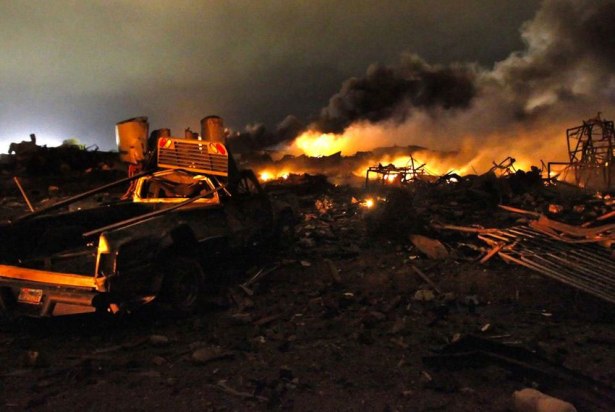
The CSB studies chemical safety accidents, such as the 2013 explosion at the West, Texas fertilizer plant, and develop new safety measures.

 
The controversies at the US Chemical Safety Board (CSB), which investigates US chemical accidents, continue. On June 22, Vanessa Sutherland abruptly resigned her job as the CSB’s chairperson and officially fired managing director Daniel Horowitz from his post.

Horowitz had been on paid administrative leave since June 2015 over accusations of mismanagement and leadership deficiencies. According to public sources, Sutherland’s sudden action shocked Horowitz. He has said the three-year delay in his termination speaks to the ‘feebleness’ of the charges against him and that he and his lawyers had tried to settle the matter multiple times, but their proposals were rebuffed. He has appealed his removal to the federal civil service court, and still wants to be reinstated as the CSB’s managing director.

The agency’s previous chairman, Rafael Moure-Eraso, was forced to resign over mismanagement allegation in March 2015, amid congressional and White House pressure. Moure-Eraso who was never prosecuted, provoked a backlash simply by pushing for significant safety changes in chemical industry practices. In addition to these personnel issues, President Trump has twice proposed to defund the agency.

Currently Kristen Kulinowski, who has served on the CSB since August 2015, is filling in as the agency’s ‘interim executive authority’.

Posted by Helen Gillespie

Can Chemicals Management Solve the Challenge of Microplastics?

Plastic pollution image cropped

Plastic and microplastic pollution is a growing problem. Image courtesy of Pixabay.

Possible solutions to the growing volume of microplastics pollution around the world were discussed at the Helsinki Chemicals Forum (HCF2018) last week in Helsinki, Finland. Experts from a variety of organizations considered what help chemicals management regulations might provide.

Plastics are an integral part of the global economy, and production volumes are forecast to double over the next 20 years. Microplastics originate both from fragmentation of ‘macroplastics’ and from direct manufacture of products such as microbeads.

The pollution of oceans and surface waters with microplastics is widespread. For example, the Ellen MacArthur Foundation estimates that 8 million tonnes of plastics enter the ocean each year.

Jane Bremmer, with the National Toxics Network in Australia, pointed to a lack of regulations to help resolve the issue. Calling microplastics a “new toxic timebomb”, she said contaminants leached by plastics and plastics packaging are key problems. Her organization has laid out a plan of action that includes a local, national and global multi-sectoral and multi-stakeholder approach to solutions, including chemicals management and regulations through the use of global instruments such as SAICM and others. She called for chemical regulations to be used to “turn off the tap, mop up the mess and clean out the cupboard.”

Steve Russell, from the American Chemistry Council, which represents plastics manufacturers, said his organization believes that waste management is a more important priority than chemicals management as a solution to this problem.

The EU Commission’s Valentina Bertato, policy officer sustainable chemicals with the REACH Sustainable Chemicals unit, pointed to single-use plastics as a major barrier to a circular economy. Plastics and microplastics are a policy priority for the commission, as they create an unacceptable risk, and while chemicals management is not the only solution, it is part of the solution. She added that the goal is to use plastics responsibly.

An industry organization called the CEFLEX Initiative was launched 18 months ago, a collaborative initiative of EU companies looking to make flexible packaging more compatible with a circular economy. Graham Houlder, CEFLEX’s managing director, said the organization now has 76 companies including producers, sorters, recyclers and one retailer. He said that plastic products need to be designed for a circular economy and is a challenge that should be solved by industry, not regulators.

So how could chemicals management be a part of the solution of microplastics pollution? Panelists identified three area where it could be part of the solution – during the product design phase to ensure recyclability, with regulations on biodegradable and oxo-degradable plastics, and with regulations governing the intentional release of microplastics.

Reported by Leslie Burt, Chemical Matters

Closing the Gap to Achieve SAICM’s 2020 Goals

OLYMPUS DIGITAL CAMERA

Panelists at the Helsinki Chemicals Forum 2018 discussed the challenges faced by developing countries in achieving SAICM’s 2020 goals. Image copyright Messukeskus Helsinki

SAICM, the Strategic Approach to International Chemicals Management, was first adopted in 2006 and is a policy framework to promote chemical safety around the world. Its overall objective is the achievement of the sound management of chemicals throughout their life cycle so that by the year 2020, chemicals are produced and used in ways that minimize significant adverse impacts on the environment and human health.

A panel session at last week’s Helsinki Chemicals Forum (HCF 2018) examined what strategic and systematic approaches could be put in place to support developing countries as they work to achieve the goals of SAICM and to lessen the risk of a growing gap between developed and developing countries.

Panelist Li Cangmin, who works at the Solid Waste and Chemicals Management Center in China’s Ministry of the Environmental Protection, outlined steps being taken by China’s government at the national level. These steps include risk assessments, toxicity testing and monitoring, and R&D into safe alternatives. In the area of chemical environmental management, China is comparing itself with developed countries and learning as much from them as possible.

Thierry Decoud, with Argentina’s Secretariat of Environmental Control and Monitoring in the Ministry of Environmental and Sustainable Development, said that his country has developed a strong regulatory framework over the past 30 years for handling hazardous waste. However, while specific regulations have been developed for specific hazardous chemicals, so far the country has not yet developed or implemented any umbrella regulations for chemicals management. Following its success with waste management regulations, the government is now prioritizing the development of chemicals management regulations.

Johanna Lissinger Peitz, senior advisor and chief negotiator on climate change with Sweden’s government, said her country has a long history of helping other countries to build national legislation for sound management of chemicals and waste. Such help can include building core competencies and training programs, all depending on what the structure of the country’s chemical industry looks like. In general, she added, needs include establishing legislation with clear responsibility to industry, establishment of enforcement mechanisms, and national systems to ensure costs are included in government budgets. Most of all, she said, if we are serious about the challenges of chemicals and waste, developing countries need to prioritize this, otherwise it is very difficult to help them.

A final perspective was provided by David Williamson, associate director with the European Bank for Reconstruction and Development (EBRD). His bank focuses on project financing in the private sector, primarily in the Middle East. It is also very involved in environmental infrastructure in water, wastewater and solid waste management. Barriers he says his bank sees include the initiation of policy, then sustaining it over the long term. He added that you need an engaged partner on the government side, otherwise you won’t have an institution to put in place. Almost as important is getting private industry involved, because they are the ones who understand the technical issues and solutions.

Posted by Leslie Burt, Chemical Matters

What’s Next for Europe’s Chemical Regulations?

ECHA screenshot

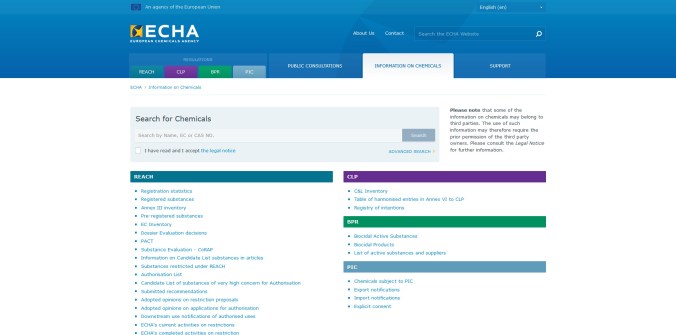
ECHA’s REACH database is the most comprehensive chemicals database in the world.

At the end of May, the final registration deadline was passed for REACH, Europe’s chemicals regulations. This deadline affected companies that manufacture or import substances in low volumes, between one and 100 tonnes a year. REACH now regulates all chemicals on the EU market, and the gathering of data on substances on the European market is now complete, resulting in what the European Chemicals Agency (ECHA) says is the most comprehensive chemicals database in the world.

Bjorn Hansen, the new head executive director of ECHA, which oversees the implementation of REACH, spoke at last week’s Helsinki Chemicals Forum, and outlined his vision for the organization’s next five years.

Hansen characterized REACH as a driver of economic competitiveness for the EU. He said that by ensuring the same protections for human health and the environment along with a clear legal framework for controlling substances on the market, REACH provides EU businesses with an advantage over their non-EU counterparts.

He also looked at the results of the recently conducted REACH Review, which indicated that improvements can and will be made – such as improvements in protections, efficiencies in training, tools for information gathering and safety data sheets.

Looking ahead, REACH has a role to play in reducing uncertainties for business while improving environmental sustainability. For example, he said, consider the introduction of a new substance. Most new chemicals are initially produced in small quantities, and if successful the production quantities will grow. Under REACH, this means the data pack on the substance will grow as well. If problems arise with the chemical, they will more likely be detected and addressed when production quantities are small, thus creating less of a business problem down the road.

Uncertainty is bad for business, he said, adding that the focus in the coming five years will be to work together with businesses to create a better knowledge base on chemicals.

Reported by Leslie Burt, Chemical Matters