Chemical Footprint Project Releases Report that Scores Product Chemical Content

The Chemical Footprint Project’s second annual report reveals chemical footprinting moves to the mainstream. A diversity of companies across sectors, sizes, and the globe participated in the 2017 Report – demonstrating its relevance and application to a broad array of companies that sell and/or manufacture apparel and footwear, building products and furnishings, packaging, medical devices, household and personal care products, toys, and electronics. Participating companies had annual revenues totaling over $670 billion.

“For the first time ever, companies are quantitatively measuring and reporting their chemical footprint,” highlighted Dr. Mark Rossi, lead author of the report and Executive Director of Clean Production Action. Companies participating in the 2016 Survey demonstrated how to measure their footprint and revealed their reductions in hazardous chemical use. Over the past two years participating companies that quantified their footprint reduced their use of chemicals of high concern in products by 416 million pounds –enough to fill over 3,600 swimming pools.

“CFP is making data available for benchmarking and gap analysis, which are critical for us to understand where our company and our suppliers are on the journey to more sustainable chemicals,” explained Zach Freeze, Senior Director for Sustainability, for Wal-Mart Stores, Inc., which is the first retailer to participate in the annual survey and is now a CFP Signatory.

Investors and purchasers now have access to data that enables the benchmarking of firms on their progress to sound chemicals management, and companies can assess where they stand relative to peers and identify and prioritize opportunities for improvement:

  • For companies selling liquid-type goods such as household cleaning and personal care products, large companies scored higher for metrics that require policies, systems, and procedures for safer chemicals, while small companies scored higher for footprinting and transparency to the public.
  • For companies selling hard products such as clothing, furniture, and electronics, large companies scored higher across all indices, followed by medium companies, and then small companies. We attribute the higher scores for large companies to greater awareness of chemicals in their products and supply chains, greater resources to manage  chemicals, and greater need to have corporate policies in place to develop and implement chemicals management systems.

The CFP results reveal clear steps to environmentally sound chemicals management:

  • Corporate Policy: establish a comprehensive chemicals policy.
  • Inventory: know the chemicals in your company’s products and supply chains.
  • Measurement: quantitatively measure your company’s chemical footprint, set measurable goals, and monitor progress to these goals.
  • Transparency: engage the public, institutional purchasers, and investors in your firm’s journey to effective chemicals management by sharing publicly your CFP answers and score.

Tracking chemical inputs and measuring progress to safer chemicals is an important metric in tracking progress to the global Sustainable Development Goals (SDGs) and meeting corporate reporting standards such as those developed by the Sustainability Accounting Standards Board (SASB).

The annual CFP Report provides a clear map for benchmarking corporate progress to safe and sustainable products. The four pillars of CFP – Management Strategy, Chemical Inventory, Footprint Measurement, and Disclosure & Verification – enable participating companies to benchmark their progress internally and externally, and empower investors and purchasers to evaluate and hold companies accountable.
TSCA Rules Weakened Under Trump-Pruitt

The Environmental Protection Agency (EPA) is morphing into the Environmental Un-Protection Agency. Or perhaps the Environmental Destruction Agency. Call it what you will, rolling back rules that have taken decades to implement is a move in the wrong direction.

These are the first rules issued since Scott Pruitt, a former chemical industry lobbyist, took charge of the EPA. What do they include? Loopholes that disregard exposures to the most vulnerable and susceptible populations which the Toxic Substances Control Act (TSCA) sought to protect.

What began as an effort to update existing inadequate rules has deteriorated into weak versions that favor the chemical industry. The initial draft version of these rules were the result of extensive public consultation that included chemical industry manufacturers, retailers, health impacted groups, medical professionals, and public interest groups. Everyone had a say. The draft rules had bipartisan support from Congress and the Obama White House and were applauded by health experts for creating a rigorous process to identify and control harmful exposures to toxic chemicals linked to significant health threats link cancer, reproductive disease and learning disabilities.

Despite these advances, the rules that have been released were revised and scaled back without public input and do not reflect the input of the various groups. They only reflect the chemical industry’s objectives. So sad; this was not what the Frank R Lautenberg Chemical Safety Act set out to achieve.

A business case for sustainability

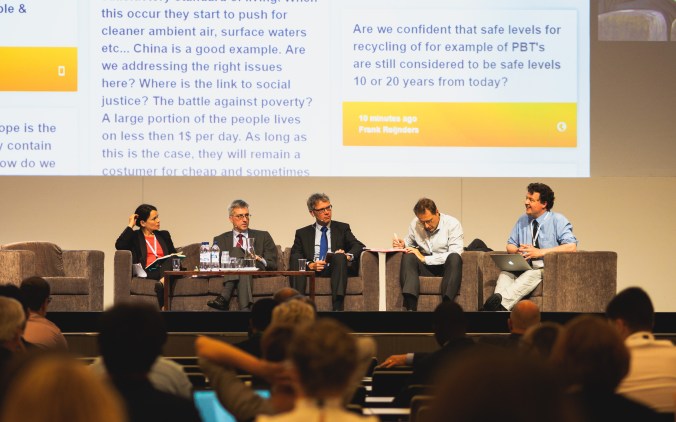
Matias LöyttyniemiA panel discussion on the business of sustainability was held at the Helsinki Chemicals Forum, June 8-9 in Helsinki, Finland. The panel, comprised of experts from around the world, discussed what efforts are underway in their countries to support sustainability relating to the use of chemicals.

Ricardo Barra, Dean with the University of Conception, in Chile, provided a snapshot of the situation in his country. The environment there is changing rapidly, at the same time poverty is decreasing rapidly. Emerging issues relating to sustainability include electronic waste, endocrine disrupting chemicals (EDCs), plastics in the environment, open burning of waste, and nanomaterials, to name a few. Chemical and waste production has been growing rapidly in Chile, outstripping the government’s ability to register the chemicals.

Qian Cheng, Deputy Head of Greenpeace East Asia in China, presented the results of tests that Greenpeace conducted near an industrial park in China, which showed the magnitude of the chemical pollution problem in China. In the study, they found a large number of hazardous chemicals (224 in all), of which 26% were subject to permit. The scale of chemical industrial production in the country is huge. For example, 18,208 of 25,000 chemical enterprises are registered to produce hazardous chemicals. Of 45,643 chemical substances registered in China, only 2,828 are being monitored. Therefore, a high proportion of chemical releases cannot be readily identified in environmental samples. And further, it makes it extremely difficult to assess the precise health and safety impact of these substances.

Timo Unger, Manager of Environmental Affairrs with Hyundai Europe, discussed how European manufacturers have reduced the environmental impact of car production over the past decade. He also outlined the challenges manufacturers face as downstream users trying to develop substitutions for hazardous substances, which can take from 3-5 years between development and testing. A project his company has started, called Global Regulatory Monitoring Project, will provide a global overview of all regulatory information. However, he commented that it would be beneficial if international organizations, such as the OECD or WTO, UN Environment or even ECHA, would assist in such projects.

Finally, Hartvig Wendt, Executive Director, Head Policy Centre Sustainability with CEFIC in Belgium, pointed to Europe’s declining importance in the global chemicals industry, and asked if after 10 years of REACH, a purely regulating scheme is the best path for the future. He summed up by pointing to a potential for Europe to put more emphasis on innovation, possibly through an incentive scheme rather than a regulatory scheme, as a means of achieving the goal of chemical safety.

Posted by Leslie Burt

Revolutionary Chemical Regulations Celebrate Milestone

hcf-2017-helsinki-chemicals-forum-circular-economy.jpg

Speakers from the chemical industry, governments and organizations shared minds and viewpoints at the Helsinki Chemicals Forum.

Celebrating the 10th anniversary of the REACH regulations, keynote speakers and panelists at the recent Helsinki Chemicals Forum (HCF) examined what the chemicals legislation has accomplished so far.

The REACH regulations have two main goals. The overriding aim is to protect human health and the environment by identifying chemical substances and regulating them through a four-part process of registration, evaluation, authorization and restriction. The second goal is to spur innovation and competitiveness in the European Union’s chemicals industry.

So far, over 11,500 companies have complied with the legislation with over 60,000 registrations.

When it was enacted, “the REACH regulation was revolutionary in worldwide chemicals policy,” said Geert Dancet, ECHA’s Executive Director, in a keynote address at HCF. “Before REACH, the responsibility was with the regulators to prove that a substance was dangerous – a situation that resulted in approximately 140 existing substances being regulated over 14 years.

“After REACH, the burden of proof is now with the companies who make chemicals,” he added. “They have to register their chemicals, documenting their hazards, the likely levels of exposure and the purposes for which they are used. And companies also need to demonstrate how they can be used safely.

“The evidence shows that it has not been easy, but it is being achieved.”

Challenges are still ahead. Bjorn Hansen, unit head with the European Commission, noted that many dossiers are still not compliant, and testing has proved to be very difficult due to animal protection provisions in REACH. Alternative test methods are being developed, but have taken much longer than originally anticipated. And because of the incomplete dossiers, few substances of very high concern have as yet been identified.

Jan Wijmenga, with The Netherlands government’s ministry of infrastructure and environment, said that although more focus is needed on new substances such as nanomaterials, REACH has been successful so far in making more data available on substances. Looking down the road, he said REACH needs to be connected with other legislation, such as that related to occupational health and safety, waste and water, in order to support the development of the circular economy.

Andrea Paetz, Director of Regulatory Policy with Bayer AG, says that REACH has addressed many of the weaknesses of previous legislation, although its switch in burden of proof was very new to the chemical industry. So far, from the industry perspective, under REACH, data collection is more systematic and the fact that the regulations apply uniformly throughout the EU is very positive. Challenges for industry, particularly SMEs, include the amount of work in collecting data, making updates, and improving dossiers.

Environment Canada’s Jake Sanderson, provided an interesting perspective on the impact of REACH on government policy outside the EU. He said that in 2006, Canada’s existing hazardous chemicals program had reviewed a total of 69 substances over 10 years – a very slow process. Staff looked at REACH as it was being introduced, and watched how it was received by industry in Europe. In addition, they also considered the legislation across the border in the United States. Readiness and political will came together, and Canada’s new Chemicals Management Plan was launched in December 2006. Sanderson said that key priority areas included having a government-wide approach, targeting chemicals of higher concern, having transparent, predictable timetables, integrating research and monitoring programs to align with the priorities, looking at international collaborations, and enhanced engagement with various groups through the supply chain. As a result, 2,800 assessments were completed in 10 years, 370 substances were found to be harmful and 80 risk management plans were created. Next steps, beyond 2020, include more cross-cutting issues, such as pharmaceuticals in the environment.

Looking down the road beyond REACH’s first 10 years, the panel members agreed that it would be ideal to be able to share information internationally by using existing facilities and tools that have already been developed.

Posted by Leslie Burt

EPA Limps Ahead with TSCA Notices

Despite the continuing debate about which chemicals are toxic and which aren’t, the EPA is issuing new chemical notices. Two such notices were recently issued in the Federal Register determining that 28 new chemical notifications are “not likely to present an unreasonable risk of injury to health or the environment (82 Fed Reg. 19044 and 19046). Yet some 700-800 pre-manufacture notices (PMN) are generated annually; those 28 substances represent a drop in the bucket. It’s good that the EPA is managing to get some scientific results finalized, not so good that they appear to be avoiding PMNs that might require restrictions.

This snail’s pace is not really the EPA’s fault. President Trump’s election and subsequent dramatic budget cuts to EPA programs have sown confusion throughout the agency.

The Chemical Safety Act spent years being argued and revised before finally being signed into law in June 2016. It was designed to replace the existing and woefully out-of-date Toxic Substances Control Act (TSCA) with contemporary science, new safety standards, increased chemical transparency and consistent funding to drive a cleaner, safer environment. Yet TSCA is virtually on hold, frozen in a mire of budget controversy.

The Chemical Safety Board (CSB) is on the verge of elimination, not because it is not valuable, but because it points out poor industry risk management activities that result in accidents and death. President Trump wants to sweep the CSB and its findings under the rug.

The EPA’s Integrated Risk Information System (IRIS) program, which assesses the risks of toxic chemicals, is also targeted for elimination. In an IRIS assessment, the agency provides expert scientific judgments on how much exposure to a particular chemical is safe. EPA regulators in the U.S. and abroad use these numbers to establish cleanup levels for pollution in air, water and soil. In the U.S., IRIS values affect the affordability and degree of cleanups as well as a polluter’s financial liability. But it too is on the chopping block.

The list goes on, slashing program after program, removing bans on toxic substances (such as lead in bullets), removing corporate accountability, removing scientific scrutiny. President Trump’s dislike (and lack of understanding) of science and the regulatory environment appears to be the motivation for the budget reductions. But if he thinks that reducing regulatory oversight is going to be good for U.S. business, he’s wrong.

As the world becomes a circular interconnected marketplace, the challenge of addressing global concerns has gained urgency, propelling standards such as the Globally Harmonized System (GHS) that ensure understanding and consistency worldwide. U.S. regulations are intimately tied into this global regulatory environment. Rolling back regulations will damage U.S. opportunities overseas. Products containing toxic materials will not be allowed into countries that have moved forward with their environmental laws. The European Chemical Agency’s (ECHA) REACH regulation, for instance, requires importers to provide comprehensive substance identification, encourages the use of safe chemical alternatives, and restricts the import of toxic Substances of Very High Concern (SVHC). Lead is on the list, which means that those lead bullets will not be allowed for sale in the European Union (EU). Other countries around the world are developing similar regulations and restrictions. Where’s the business benefit? There isn’t one for going backward, only forward. And this is not the direction the EPA appears to be going.

Approving substances such as those in the recent PMN notices is just one small part of the EPA’s responsibilities. The agency should be restricting toxic substances, such as lead, not removing restrictions that have the potential to make the entire U.S. a Superfund environment.

Published by Helen Gillespie

Canada Takes Action to Ban Asbestos

After many years of delay, the Canadian government recently announced that it will enact a comprehensive ban on asbestos and asbestos-containing products by 2018. The country’s long history of asbestos mining had ended when its two last asbestos mines closed in 2011. However, asbestos itself and its use in products was not banned, despite years of pressure from health advocates for the group of carcinogenic minerals to be outlawed.

Citing the need to protect the health and safety of Canadians, the government said it is developing new regulations that will ban the manufacture, use, import and export of asbestos under the Canadian Environmental Protection Act, 1999 (CETA). Also planned are new federal workplace health and safety rules to drastically limit the risk of exposure to asbestos. In addition, an existing list of asbestos-containing buildings that are federally owned or leased will be expanded, and national, provincial and territorial building codes will be updated to prohibit the use of asbestos in new construction and renovation projects.

In April, the federal government took another step when it updated its international position on the listing of asbestos as a hazardous material and supported the listing of chrysotile asbestos to the Rotterdam Convention.

“By supporting the listing of chrysotile asbestos to the Rotterdam Convention, Canada is taking a concrete step to promote responsible management of this harmful substance globally,” said Catherine McKenna, minister of environment and climate change. “In Canada, we will also put in place regulatory measures to protect the health and safety of Canadians as we move forward toward a ban on asbestos.”

Now a consultation document has been published that outlines the proposed regulatory approach and solicits stakeholders’ views on the proposed measures.  The document asks for comments within 45 days of its publication. Following that, proposed regulations will be published by December 2017 and final regulations in the fall of 2018.

The proposed regulations would target asbestos, defined as any fibrous form of mineral silicates belonging to the serpentine or amphibole groups of rock-forming minerals including actinolite asbestos; amosite; anthophyllite asbestos; chrysotile; crocidolite; and tremolite asbestos. New stand-alone regulations under section 93 CEPA would prohibit the import, use, sale and offer for sale of asbestos, as well as the manufacture, use, sale, offer for sale and import of products containing asbestos. The export of all types of asbestos and products containing asbestos would also be prohibited.

The consultation document can be viewed on Environment and Climate Change Canada’s website.


R.E.A.C.H-ing for Higher Standards in Global Chemical Management

Matias LöyttyniemiThe challenges of defining and managing chemicals in today’s interconnected global environment are more difficult than ever before. Despite the publication of the TSCA (Toxic Chemical Substances Act) regulation in the United States, the recent political changes are casting doubt on how or what will be changed, despite the pressing need for change.

Regardless of what is happening in the US concerning chemical regulations, the European Commission (EC) has been intent on removing and reducing toxic substances from industrial products that are manufactured in and imported into Europe. To this end, the European Chemicals Agency (ECHA) was formed to draft and manage a new regulation for monitoring this process: REACH (Registration, Evaluation, Authorisation and Restriction of Chemicals).

REACH establishes procedures for collecting and assessing information on chemical substance hazards and risks

It requires companies to register the substances they manufacture in, or import into, Europe above one tonne a year. The goal is to gather information on chemicals within the European Union (EU) in order to manage chemical risks in a meaningful way, as well as to promote the gradual substitution of the most toxic substances.

What makes the regulation different from most is that REACH is not a voluntary standard. It places the burden of proof on industry to demonstrate that a substance is safe.

Rather than acting as a watchdog and demonstrating that a substance is unsafe, ECHA is evaluating the chemical data that the manufacturer provides. As a result, there is now a much better understanding of chemical substances, with the most dangerous substances being replaced with safer alternatives.

One of the greatest hurdles REACH is addressing is the cost to comply. It is not only expensive to reconfigure a product or substitute a less toxic substance, it is also expensive and time-consuming to provide the information to REACH. Historically, businesses have been more focused on profits than product safety so any additional cost that impacts their bottom line is met with resistance.

The REACH regulation and the challenges and issues surrounding chemicals management will be addressed at the upcoming Helsinki Chemicals Forum (HCF), the leading international discussion forum for chemicals safety and sound chemicals management.

HCF not only provides a forum to examine the REACH standard within Europe, but also how it fits within the global community of new standards that many countries are implementing to better manage chemical safety and reduce exposure to toxic substances.

HCF 2017 will be held from 8-9 June, 2017 at the Messukeskus Helsinki Convention Centre in Helsinki, Finland. The two-day event addresses opportunities and challenges for chemicals regulation, with panels covering the United Nation’s 2020 goals on chemicals management, sustainable development, chemical assessments, chemical risk and much more. An international collection of speakers from regulatory bodies, industry associations and NGOs will provide insights, with speakers from ECHA, the US EPA, Environment Canada, CEFIC, OECD and many more.

For more information about HCF, visit http://www.helsinkicf.eu.

Delay in EPA’s Chemical Storage Rule Overlooks Inadequate Chemical Management

The Environmental Protection Agency’s (EPA) new Administrator Scott Pruitt is supporting an industry request to delay and further review the amended chemical safety regulation. This regulation came about in response to the 2013 West, Texas chemical-related explosion and imposes stricter requirements for industry-prepared risk management plans. The amendment, called the Chemical Storage rule, zeroes in on accidental release prevention requirements by specifically focusing on safe chemical storage.

Regulations already exist to reduce chemical management risk, but these haven’t prevented lack of safety procedures, safety plans or accidents. When these occur, it is not necessarily the business that suffers but everyone else. For instance, the West, Texas explosion caused by poorly stored ammonium nitrate may have destroyed the plant and put the fertilizer company out of business, but it had a deeper impact on the surrounding community because it not only resulted in the deaths of 15 workers, but also damaged buildings for miles around. Greater oversight would have unearthed and corrected the problem and reduced risk.

The delay in implementing the Chemical Storage rule was pushed by chemical industry lobbyists who complained that the rule could make it easier for terrorists and other criminals to target refineries, chemical plants and other facilities by requiring companies to make public the types and quantities of chemicals stored on site. This is nonsense. Such information is already required by chemical management rules, including the Department of Homeland Security’s Chemical Facility Anti-Terrorism Standard (CFATS), 6 CFR Part 27, which provides just such oversight already but only if the chemical exceeds threshold quantities. If those quantities aren’t reported – which is often the case – then either CFATS should be strengthened or the Chemical Storage rule should be implemented.

Frankly, businesses do not provide enough information now about chemicals on site. Many of these chemical substances are not stored correctly or kept in areas where they should not. Take, for instance, the 2014 chemical spill of crude 4-methylcyclohexamenthanol (MCHM) that was released into the Elk River in West Virginia upstream of the principal water intake and treatment plant for the region. Oops. Not only was the MCHM stored in an aging compromised container (bad), it was stored in an inappropriate location (very bad). It would have cost Freedom Industries, the company that stored the MCGM, money to either replace the storage container or move the substance to a different location. That’s what the lobbyists are really objecting to, that poor chemical management will be revealed and that businesses will need to improve their chemical management activities. Which will cost money to implement. Money that’s not been budgeted and which will cut into profits.

Hazardous chemical incidents occur frequently. More than 1,500 chemical releases or explosions were reported from 2004 to 2013, causing 58 deaths and more than 17,000 injuries, according to the Environmental Justice Health Alliance, an advocacy group. That’s an accident rate of almost 14 a month or every other day. How can this possibly be acceptable?

The public is the one who pays after an incident, not the perpetrator. Right now businesses are already required to submit reports concerning the types and quantities of chemicals stored on site. Many different regulations already require this, but it is difficult to ensure compliance when there is little oversight. For instance, Fire Code regulations require that this information be provided annually in order for first responders to accurately respond to any incidents. The proposed Chemical Storage rule simply tightens the safety requirements. Any claims that it impedes business is a smokescreen for non-compliance. All such facilities already have security measures in place to prevent unauthorized access. Delaying the EPA Chemical Storage rule would not divert resources from existing safety programs if those programs aren’t in fact ensuring safety in the first place.

Posted by Helen Gillespie